The difference between AC and DC charging of an electric vehicle is not just a technical detail. It is the difference between comfortably charging overnight at home and quickly topping up your range on the road. Once you understand how AC and DC charging work, you will more easily choose a home wallbox, better estimate the real charging speed, and stop expecting your home charger to “pull 150 kW”. In this article we will clearly explain how AC and DC charging differ, which is faster, which is cheaper, and when to use a wallbox and when to use a DC fast charger.
What is the difference between AC and DC charging?
The main difference: with AC charging (a wallbox at home), the alternating current is converted to direct current by the onboard charger in the car, so the speed is limited by the car itself. With DC charging (a fast charger on the road), the conversion happens directly in the station and the current goes straight into the battery, which is why it is significantly faster. Use AC at home overnight, and DC on the road.
An electric vehicle's battery always works with direct current (DC). The difference between the two charging methods lies in where the current from the distribution grid (alternating, AC) is converted to direct current:
with AC charging the conversion takes place inside the car (in the onboard charger),
with DC charging the conversion takes place outside the car, directly in the charging station.
And it is exactly this one place where the conversion happens that determines how fast, where, and at what cost you charge.
AC vs. DC charging comparison table
Parameter | AC (wallbox at home) | DC (fast charger) |
|---|---|---|
Current type | Alternating – converted in the car | Direct – straight into the battery |
Typical power | 3.7–22 kW | 50–400 kW |
Charging speed | hours (overnight) | tens of minutes |
Where it is used | home, work, parking lots | motorways, road trips |
Price per kWh | lower (home tariff, can be controlled by PV) | higher (public network) |
A layman's example from everyday life
Imagine the battery as a water tank:
AC charging is like carrying water in buckets and pouring it into the tank through a narrow funnel. That funnel is the onboard charger in the car – no matter how much water you pour in, only as much gets through as the funnel can handle.
DC charging is like a hydrant with a hose that sends water straight into the tank. No narrow funnel, which is why it is much faster.
That is why you charge more slowly at home than on the motorway, and why the power fluctuates during charging.
What is AC charging and why is it the most common at home?
AC charging means charging with alternating current, which you have in the ordinary distribution grid and in household sockets. But the car does not feed it straight into the battery – first it has to convert it internally into direct current, because that is how the battery works. This conversion is handled by the onboard charger in the car, and it is precisely this that determines how fast you charge at home. That is why AC is ideal for home and work, where the car is parked for a long time.
With AC charging, the “charger in the car” is decisive
The AC → DC conversion is handled by the onboard charger (OBC, On-Board Charger). Its power is the main limit of AC charging. That is why, even with a quality wallbox, some cars do not charge any faster than the car itself allows: if a vehicle has an onboard charger of only 11 kW, you will still not get more than 11 kW out of it on a 22kW wallbox.
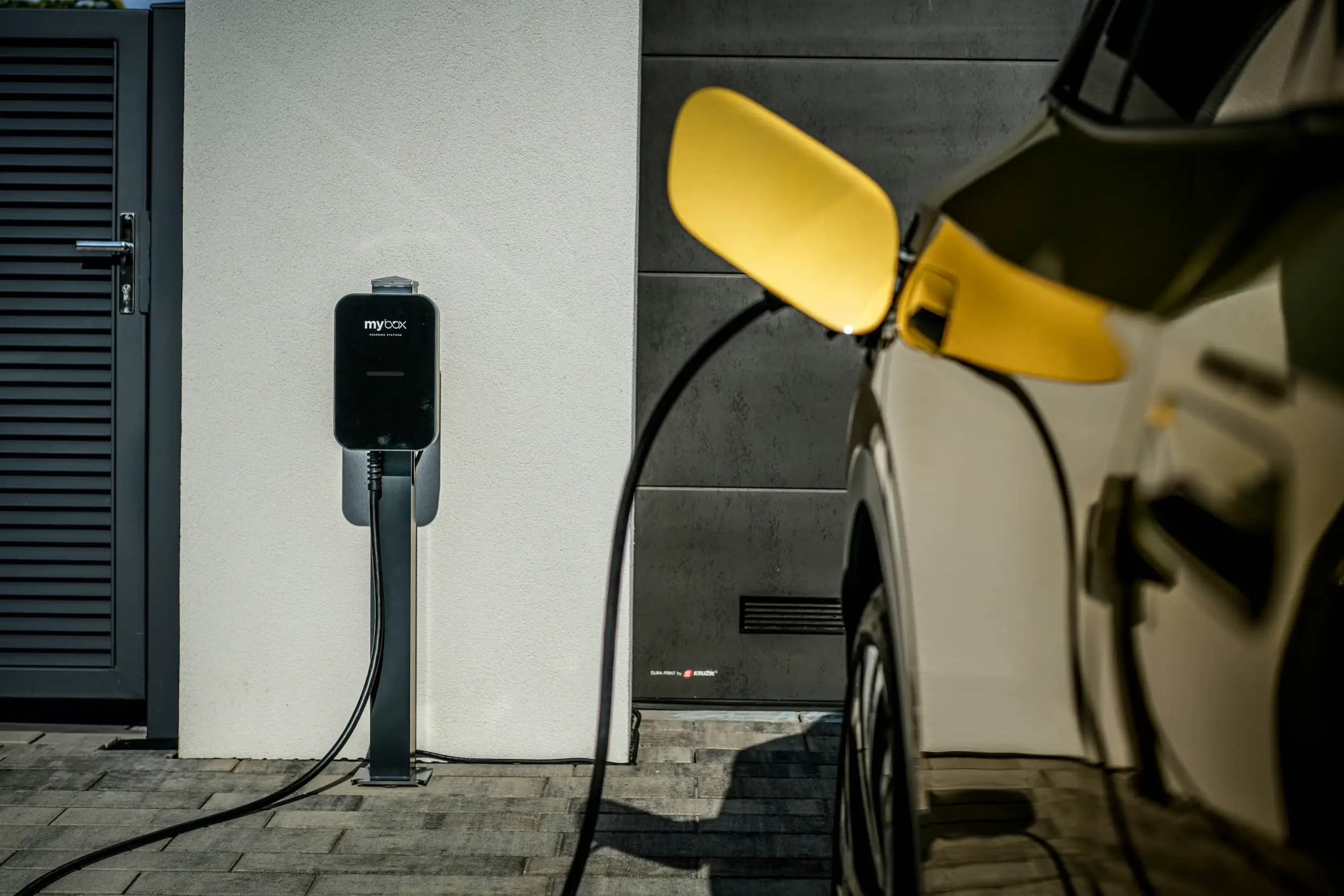
This is important to know when choosing. For a household where the car is parked overnight, an AC wallbox makes sense – for example MyBox Home (11 and 22 kW, Type 2 connector), which is suitable for home charging as well as in combination with photovoltaics and dynamic power management. If you need to measure consumption for billing – for instance in a company or an apartment building – reach for a variant with a certified electricity meter, such as MyBox Plus with MID electricity meter. For corporate and public locations, MyBox also offers the Profi and Post pedestal solutions. You can find an overview of all variants in the MyBox charging stations category.
What is DC charging and why is it called fast charging?
DC charging means charging with the direct current that the battery needs. The conversion from alternating to direct current takes place outside the car, directly in the charging station, so the current goes straight into the battery and bypasses the onboard charger. Thanks to this, DC is significantly faster than ordinary home AC charging and is used mainly on the road and at motorways, where you need to top up your range in tens of minutes rather than hours.
With DC charging, both the station and the limits of the car and battery are decisive
A high station power still does not mean you always charge at that power. The real power is determined by a combination of factors:
the maximum DC power supported by your car,
battery temperature (a cold battery charges more slowly),
state of charge (the fuller the battery, the lower the power),
the vehicle's voltage architecture and any power sharing between two cars on a single station.
That is why it often holds true that “the station can do a lot, but I charge less”.
MyBox no longer manufactures its own DC fast charger today. However, as an authorized partner of Alpitronic, it supplies, installs, and services top-tier Alpitronic DC fast charging stations of the Hypercharger series. Depending on the needs of the location, you can choose Alpitronic HYC50 (up to 50 kW) for corporate and smaller public locations, Alpitronic HYC200 (100–200 kW) for busy places, or Alpitronic HYC400 (100–400 kW) for ultra-fast charging at the highest power.
Which is better: AC or DC?
There is no universal winner – AC and DC do not solve the same thing. AC is better at home and everywhere the car is parked for a long time: you charge calmly overnight, cheaply and gently on the battery. DC is better on the road, where you need to top up your range in a moment and continue on. In practice, most electric vehicle owners handle 80–90 % of charging at home on an AC wallbox and use a DC fast charger only on long routes. So the “better” method is the one that matches the situation.
To sum it up in one sentence: with AC the current is converted in the car (slower, ideal for home and long stops), whereas with DC the current is converted in the charger (fast top-up on the road).
Which is cheaper: AC at home or DC on the road?
Home AC charging is usually significantly cheaper than public DC fast charging. At home you pay your own price per kWh, you can charge on a cheaper (for example night) tariff and smartly control charging according to the house's consumption or surpluses from photovoltaics. Public DC charging is more expensive due to the higher power, operation, and the network's margin. That is why it pays off to charge mainly at home and use DC purposefully on the road.
Moreover, a home wallbox can schedule and control charging: start it once electricity is cheap, or use energy from your own photovoltaics. This deepens the price difference compared to public DC charging even further.
The most common myths about charging an electric vehicle
Myth 1: “A wallbox charges as fast as a motorway station.” It does not. An AC wallbox is limited by the onboard charger in the car and the capacity of your home electrical installation. That is a completely different league than the tens to hundreds of kW on DC.
Myth 2: “A DC fast charger always charges at maximum power.” It does not. The real power changes according to the state of charge, battery temperature, and the limits of the car. You usually see the highest power only during part of the charging, typically at a lower battery level.
Myth 3: “An ordinary socket is the same as a wallbox.” It is not. A wallbox is safer and offers features that a socket does not have – power control and dynamic load balancing, scheduling, authorization (RFID), and protections. An ordinary socket is moreover not built for long charging at high current.
Closing tip: when to use AC and when to use DC
Do you charge mainly at home? Focus on AC and the right home wallbox. That is the cheapest and most convenient foundation for everyday operation.
Do you drive long routes? Learn how DC fast charging works and count on it on the road – ideally at a fast charger of the appropriate power.
Before you want to charge faster, always check where the real limit is: the car, the home electrical installation, or the charging station. Often something other than what you think is “braking” it.