Who is a public station operator
The Czech Fuels Act (No. 311/2006 Coll.) considers a charging station publicly accessible if its operator provides non-discriminatory access to drivers from the European Union. Conditions for authentication, use and payment may vary, but everyone must have access. This includes stations on a town square, at a hotel, in front of a shop or in a company car park open to the public. A wallbox in the garage of a family home and a station on company premises intended only for the company’s own vehicles are not among them.
A charging station operator does not need a licence from the Energy Regulatory Office (ERÚ). Section 3(4)(c) of the Energy Act (No. 458/2000 Coll.) exempts the use of electricity for operating a charging station from the activities that require a licence. A municipality, hotel or company can therefore bill for charging without becoming an electricity trader. If you power the station from your own photovoltaic system, you only need an electricity generation licence for a plant with an installed capacity above 100 kW, for an additional plant at the same connection point, or if you draw support under the Act on Supported Energy Sources.
The Fuels Act further distinguishes between a normal power recharging point of up to 22 kW and a high power recharging point above 22 kW. MyBox Plus, Profi and Post stations have normal power recharging points, Alpitronic fast charging stations have high power ones. The payment and pricing obligations apply to both groups. For recharging points of 50 kW and above, the payment requirements are stricter.
1. Registration in the charging station register
The Ministry of Industry and Trade (MPO) keeps a register of charging stations and publishes the list of publicly accessible stations. The station must be registered by its owner, and this must happen before it is put into operation. The registration covers details of the owner and operator, the number of recharging points and, for each point, its type, maximum power and connector standard, information on which points can be used simultaneously, the total power of the station, its address and GPS coordinates, public accessibility including opening hours, the name under which the station operates and the date of commissioning. The owner reports any change to these details, as well as the end of operation, without undue delay.
The registration is submitted to the MPO. You will find the procedure on the charging station register page at mpo.gov.cz (in Czech), and questions can be sent to dobijecistanice@mpo.gov.cz. The technical data needed for registration, i.e. the number of points, power and connector types, are included in the station documentation.
Registration therefore belongs in the project schedule before the station goes live. The MPO can fine the owner up to CZK 3 million for failing to report the data.
2. On-site payment without registration
The EU Alternative Fuels Infrastructure Regulation (AFIR, EU 2023/1804) and Czech law both require that drivers can charge ad hoc at a public station, without entering into a contract with the operator. The regulation has applied since 13 April 2024 and, for recharging points put into operation from that date, also specifies the payment method.
For recharging points of up to 50 kW, a device with an internet connection that enables secure payment is sufficient. Typically this is a QR code on the station display. The driver scans it with a phone, pays by card on the payment page and charging starts. For points of 50 kW and more, the driver must have a payment card reader or contactless terminal available.
We supply MyBox Profi and Post stations for public use in two versions. The first has a 5" display that shows QR codes for ad hoc charging. The second has an integrated PAX IM25 payment terminal, to which the driver holds a card directly at the station. The display and terminal are fitted during production, so the version is decided when ordering.
With the QR code version, you connect the station to the network of a charging point operator or a partner who runs public charging. The connection uses OCPP, the open communication protocol for charging stations. The QR code leads to the network operator’s app or payment page, and the network operator handles payment and billing for the driver. The station will usually also appear on their map of charging locations. With the terminal version, payments are processed by a payment service with which you sign a contract, and you manage the station in MyBox Cloud, our charging management software.
For AC stations up to 22 kW, a QR code therefore meets the requirements of the regulation. We recommend a terminal where you want to offer drivers the simplest way to charge, for example hotel guests or shoppers. For fast charging points of 50 kW and above, a card reader or contactless terminal is mandatory.
- How the driver pays
- Scans the QR code with a phone and pays by card on the payment page
- For which stations
- MyBox Profi, Post
- AFIR regulation
- Compliant for recharging points up to 50 kW
- Who processes the payment
- The charging network operator or a partner
- How the driver pays
- Holds a card to the terminal on the station
- For which stations
- MyBox Profi, Post
- AFIR regulation
- Compliant for all power levels, from 50 kW the terminal is mandatory
- Who processes the payment
- A payment service
3. Price published before charging starts
The operator of a public station must publish its prices. The details are set by the AFIR regulation. For recharging points up to 50 kW, price information must be easily and clearly available directly at the station, with all components in the order: price per kWh, price per minute, price per session and any other components. For points of 50 kW and above, the operator displays at the station the price per kWh and any occupancy fee in CZK per minute. For these points, the price per kWh is the basis of the price. The operator may charge a per-minute fee so that drivers do not needlessly block the station after charging.
With the terminal version, you set the prices yourself in the payment service portal. With the QR code version, the price follows the agreement with the operator of the network to which the station is connected. In both cases, the driver must see the price before charging starts, for example on a price list placed on or next to the station.
4. A meter verified by the Czech Metrology Institute
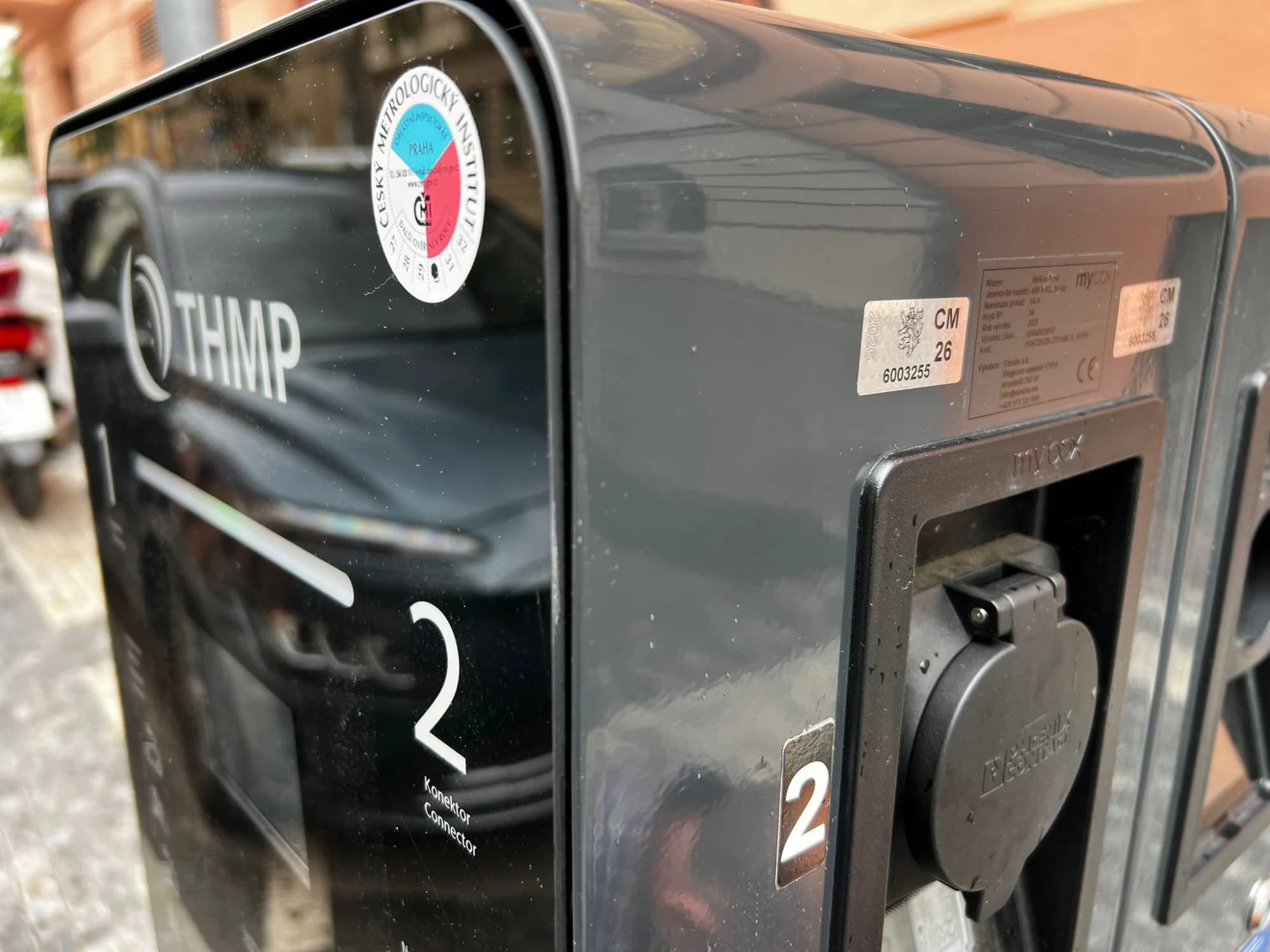
Since 1 January 2026, the metering systems of public charging stations have been legally controlled measuring instruments under the Metrology Act (No. 505/1990 Coll.) and Decree No. 345/2002 Coll. The electricity meter used for billing therefore needs type approval and verification by the Czech Metrology Institute (ČMI). Verification is valid for 4 years and is then repeated. MyBox Plus, Profi and Post stations have an electricity meter that complies with the European Measuring Instruments Directive (MID). Since January 2026, billing at a public station additionally requires ČMI verification.
MyBox Plus, Profi and Post stations have ČMI type approval for the measuring instrument. Each specific station is verified on site after installation, and the verification is requested by the station operator. After installation, we hand over the inspection report, the station type and manufacturer, the serial number, the meter’s rating plate and the type approval mark. With these documents, you submit the application to oiprahaEVSE@cmi.gov.cz. You arrange the appointment directly with ČMI, and a ČMI technician verifies the meter at the station.
For stations put into operation before 1 January 2026, there was a 90-day deadline to apply for verification. If you have an older public station and have not yet dealt with verification, contact ČMI as soon as possible. We will prepare the documents for you.
The driver can be sure they are paying for the energy actually drawn, and the operator has billing based on verified measurement.
5. Contact for drivers and data reporting
Every charging station must display a telephone contact in case of problems while charging. A public station must also give drivers information on compatibility with electric vehicles, i.e. connector type and power. Within 30 days of commissioning, the operator of a public station provides the Ministry of Transport with information on the driver identification methods and payment methods at the station. Then, every year by 28 February, it reports to the MPO the amount of electricity consumed for charging in the previous year. The annual report applies to all charging station operators, public and non-public.
You will find the consumption data in the system in which you manage the station.
What it looks like in practice
A municipality installs two MyBox Post stations with a payment terminal in the car park by the sports hall. Before going live, the municipality registers them with the MPO. After installation, it receives the documents from us and applies to ČMI for verification of the meters. In the payment service portal, it sets the price per kWh and, if it wishes, a per-minute fee after charging is complete. A driver arrives, reads the price list, holds up a card and charges. Within 30 days, the municipality reports the payment method at the station to the Ministry of Transport, and every February it sends the MPO the annual consumption.
What we take care of and what remains with you
We design, manufacture, install and commission the station. We hand over the inspection report, the documents for the ČMI verification application and the station documentation. At handover, we show you the payment service portal and MyBox Cloud, and we continue to look after the station as part of our service.
What remains with you is registering the station with the MPO, the contract with the payment service or charging network operator and setting the prices, the ČMI verification application and cooperation during verification, reporting to the Ministry of Transport and the annual consumption report. The law imposes these obligations on the owner and operator of the station. We will gladly help you prepare the documents.
Planning public charging? We will go through with you which station version suits the location and what to prepare before going live. You can find out more about our solution for municipalities and cities at mybox.eco/en/charging-solutions/municipalities.