A company can fairly reimburse an employee for charging a company electric car at home if it has two things: verifiably measured consumption from a certified (MID) energy meter, and a clearly defined price per kWh. Consumption split by user and location is supplied by a charging station with a MID meter, while the price can be derived from the Czech MPSV travel-allowance decree (for 2026 it is CZK 7.20 per kWh) or from the real price of household electricity. The monthly settlement then runs alongside payroll and stands up to scrutiny by the accountant and the tax office.
This guide is aimed at companies, fleet managers and HR. It does not address whether to reimburse home charging (it almost always pays off), but how to do it as a verifiable process. Treat the tax and accounting layer as a general overview – always confirm the specific posting with a tax adviser.
Why home charging of a company car is a problem to solve
An employee with a company electric car typically charges mostly at home – cheaply and overnight. But the company needs to reimburse only the energy consumed by the company vehicle, not the entire household bill. Without measurement a dispute arises: how many kWh went into the car? At what price? And will it hold up under an audit?
Estimates ("roughly 200 kWh a month") are not defensible for accounting. A screenshot from the wallbox app without certified measurement is not enough across a larger fleet. The solution is therefore measuring consumption with a legally controlled instrument directly in the charging station, plus a transparent process built around it.
The key prerequisite: a MID-certified energy meter
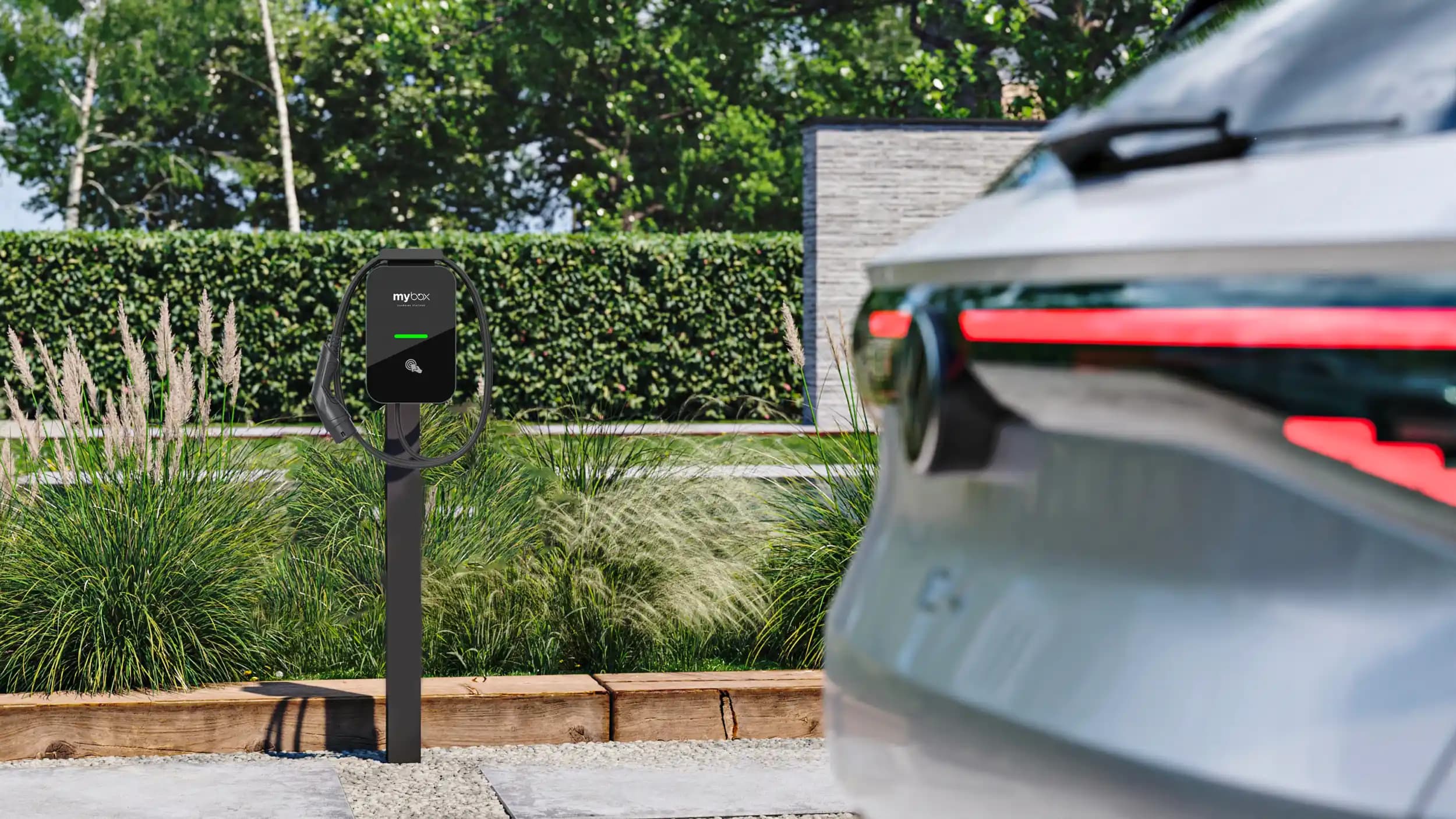
For the measured value to be legally relevant, it must come from a meter certified to MID (Measuring Instruments Directive). That is exactly the role of the MyBox Plus station, which has a built-in MID energy meter, class 1 (EN 50470-1, EN 50470-3) and measures consumption separately for each charging session.
Why isn't an ordinary meter enough? We covered the reasons in the article Why you should want a certified energy meter, even though it costs more – in short, it is about the value being defensible to a third party (the employee, the accountant, the tax office). In addition, from 1 January 2026 charging stations used for invoicing/settlement fall under legally controlled measuring instruments (stanovená měřidla) according to Czech Act No. 505/1990 Coll. on metrology and are subject to regular verification (typically every 4 years); the deadline to file a verification request is 31 March 2026. Without a certified instrument, reimbursement cannot be put on a solid footing going forward.
MyBox Plus adds an RFID reader (assign a card to a specific employee) and the OCPP 1.6 JSON protocol, so the session, user and consumption flow into the backend and into the MyBox mobile app. This secures who charged, when, and how much.
How to set the price per kWh: decree vs. real tariff
There are two legitimate approaches to valuing the measured kWh. The choice affects both the amount reimbursed and the administration.
Pricing method | Price per kWh (2026) | Advantages | Watch out for |
|---|---|---|---|
MPSV travel-allowance decree (uniform rate for company charging) | CZK 7.20/kWh (Decree 573/2025 Coll.) | Simple, uniform for everyone, independent of the employee's tariff or rooftop PV | A flat rate – may be higher or lower than the real cost |
Real price of household electricity (per invoice / tariff) | typically about CZK 3.50–4.50/kWh in the low (off-peak) tariff | Matches the employee's actual cost | Requires proof of tariff and more administration, changes over time |
The uniform decree rate is the most used in practice, because the company need not deal with individual tariffs, distribution charges, or whether the employee charged from the grid or from their own photovoltaics. If employees charge on a dynamic tariff, it is worth understanding the difference in depth – how much a kWh really costs at different hours is covered in Dynamic tariffs for EVs: how much you save. Whether home charging even raises the household bill is addressed in Will the cost of your electricity supply rise because of home charging.
Note: the specific tax treatment of the reimbursement (whether it is a payroll or non-payroll cost, and its impact on the employee) varies by situation. Have the chosen method and rate approved by a tax adviser.
Monthly settlement step by step
A working process for a company car charged at home looks like this:
User assignment – the employee has their own RFID card (or a profile in the app). Every session is logged to them.
Measurement – the MID meter in the station records the kWh of each session separately by location (home / company / public).
Data export – at the end of the month the station/backend generates a consumption overview by user and location (a report for invoicing and integration into the accounting system via OCPP).
Valuation – the kWh from home charging is multiplied by the chosen price (the CZK 7.20 decree rate or the real tariff).
Reimbursement – the amount is paid to the employee, typically together with payroll, with supporting documentation.
Archiving – the report serves as evidence in the event of a tax-office audit.
For fleets it pays to extend the same logic to company and public charging – how the individual scenarios differ is summarised on charging for companies, and central charging management ensures that neither home nor company stations overload the connection.
Worked reimbursement example (one employee, one month)
Model case: an employee with an electric car drives about 1,500 km a month and charges most of the energy at home. Vehicle consumption is about 18 kWh/100 km.
Item | Value |
|---|---|
Kilometres driven per month | 1,500 km |
Vehicle consumption | 18 kWh / 100 km |
Total consumption | 270 kWh |
Of which at home (measured by MID meter) | 230 kWh |
Of which company + public (handled separately) | 40 kWh |
Price per kWh – method A: MPSV decree | CZK 7.20 |
Reimbursement to employee (A) | 230 × 7.20 = CZK 1,656 |
Price per kWh – method B: real off-peak tariff | CZK 4.20 |
Reimbursement to employee (B) | 230 × 4.20 = CZK 966 |
Formula: reimbursement = kWh charged at home (MID) × price per kWh
The difference between the methods (here CZK 690/month) shows why it is good to choose a method deliberately and apply it consistently. The key point, however, is that the input number – 230 kWh – is verifiably measured, not estimated. That is the whole point of a MID meter.
What this means for choosing a station
If you are only just electrifying your fleet, choose a station for both home and company charging that handles measurement and user records natively. The differences between the home variant and the variant with an energy meter are covered in MyBox Home vs. Plus; for reimbursing employees, the MID meter in MyBox Plus is practically a must. This turns an accounting-disputable item into a standard, auditable process.
Rates and metrology details reflect the state as of June 2026; verify the specific tax setup with an adviser.
Frequently asked questions
What price per kWh should be used when reimbursing home charging of a company car?
The most common choice is the uniform rate from the MPSV travel-allowance decree, which for 2026 is CZK 7.20 per kWh (Decree No. 573/2025 Coll.). Alternatively, you can reimburse the real price of household electricity per the employee's tariff (typically about CZK 3.50–4.50/kWh in the low tariff), but that requires documentation and more administration. Confirm the method and rate with a tax adviser.
Why isn't an ordinary meter or a screenshot from the wallbox app enough?
For defensible settlement towards the employee, the accountant and the tax office, the value must be measured by a certified MID meter. In addition, from 1 January 2026 charging stations used for settlement fall under legally controlled measuring instruments according to the metrology act and are subject to regular verification. An estimate or a mere screenshot cannot provide that defensibility.
How does the company tell how much an employee charged at home versus elsewhere?
A station with a MID meter and RFID identification (e.g. MyBox Plus) logs each session by user and location. At the end of the month it generates a consumption overview by location (home / company / public), so you can reimburse only the kWh charged at home in the company vehicle.
Does a home station need a MID meter even just to reimburse an employee?
If you want the reimbursement on a defensible basis that will survive an audit, yes. A MID-certified meter turns the measured consumption into a legally relevant value. The MyBox Plus station has a class 1 MID meter built in; MyBox Home, as a purely domestic variant, does not primarily target certified measurement for invoicing.
How do I calculate the reimbursement amount?
Use the formula: reimbursement = number of kWh charged at home (measured by the MID meter) × price per kWh. Example: 230 kWh × CZK 7.20 = CZK 1,656 per month using the rate from the 2026 MPSV decree.