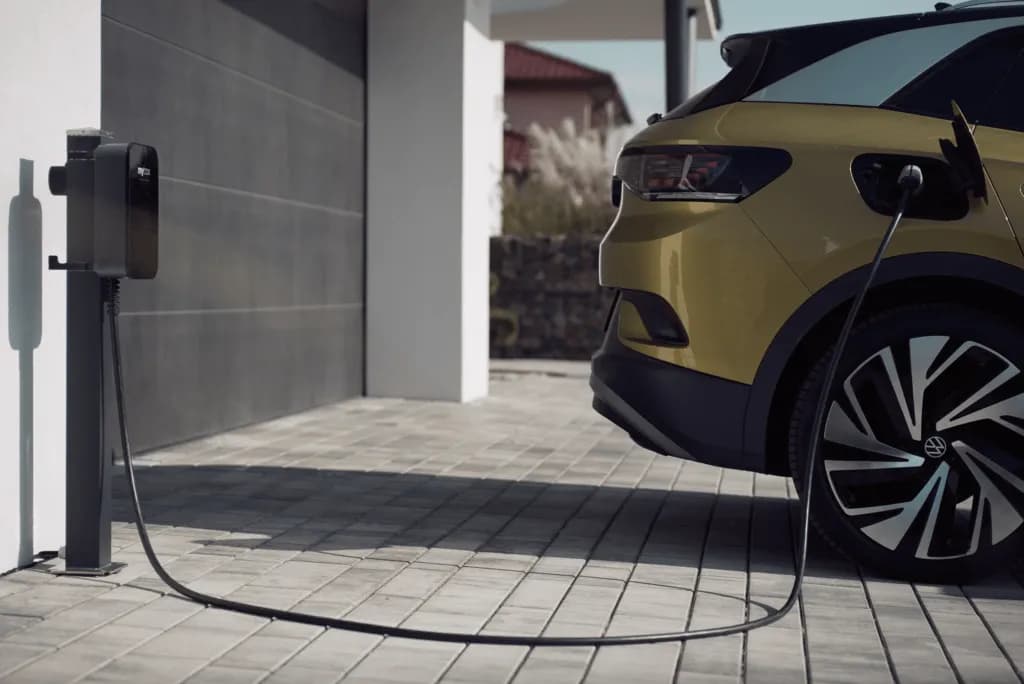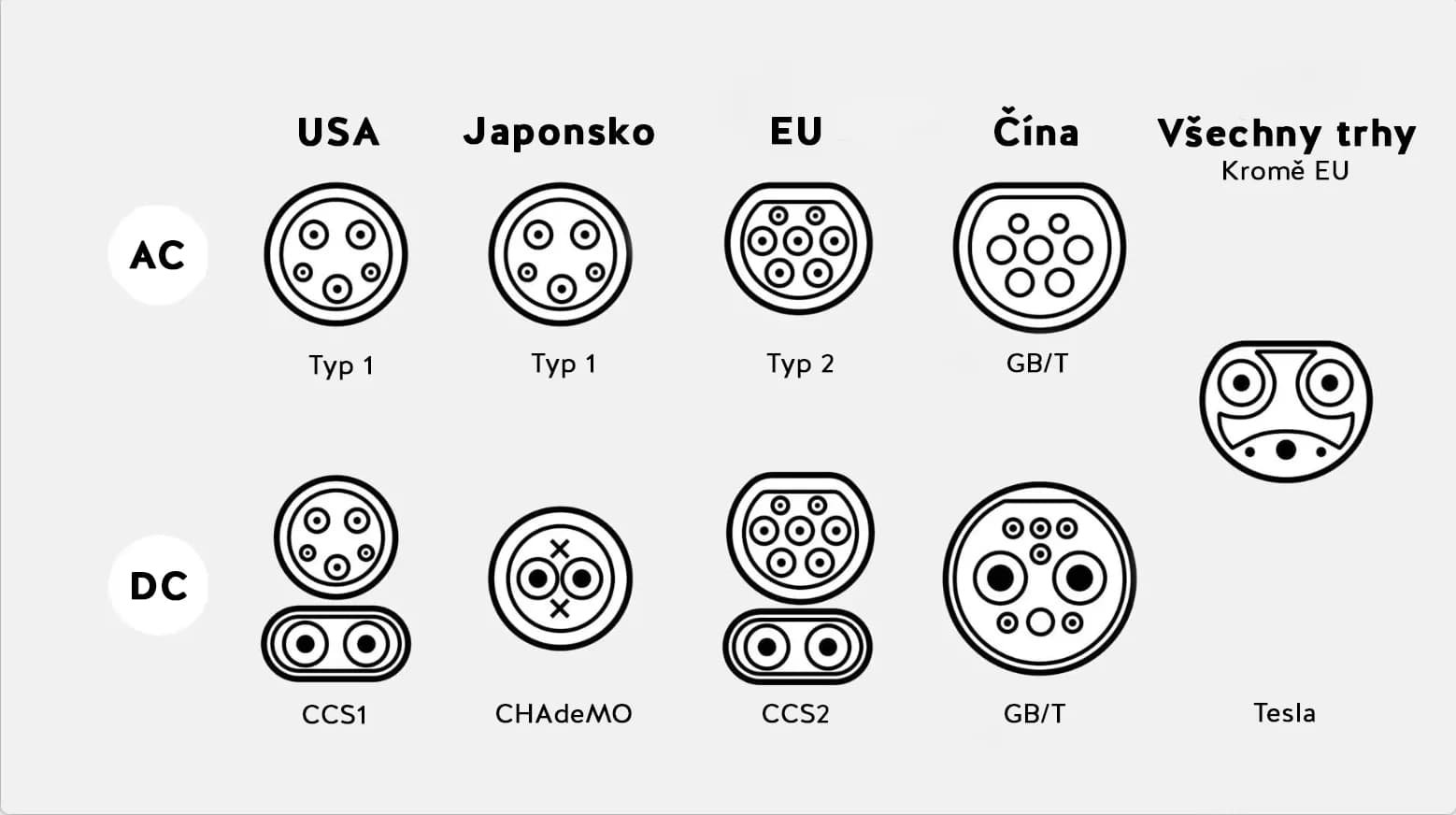
In Europe and Czechia, two connectors dominate: Type 2 (Mennekes) for alternating current (AC) charging and CCS2 for direct current (DC) fast charging. CCS2 is based on Type 2 and adds two power DC pins. On older and imported cars, you may also come across Type 1, CHAdeMO, CCS1, the American NACS, or the Chinese GB/T. New electric vehicles for the European market handle the Type 2 + CCS2 combination automatically.
If you buy a new electric vehicle designed for the European market, you do not need to worry about connectors and cables. Your new car will be equipped with a Type 2 connector (or CCS2 for fast charging). Simply plug in the cable and start charging.
Different Market, Different Connector
Things get more complicated if you import an electric vehicle from abroad – for example, from the USA or China. Manufacturers in those markets use different standards that are not always compatible with the European charging infrastructure.
Watch Out for Older EV Models
Also in play are older electric vehicles with different connectors. These cars are still on the road, and there are certainly plenty of them at used car dealerships. The overview below will help you easily get your bearings in the various types of sockets and charging modes.
Types of Charging Connectors You Will Encounter in Czechia
Charging connectors have evolved over the years, and different standards have emerged in different parts of the world. In Europe today, Type 2 and CCS2 dominate, but electric vehicles with other connectors are still on the roads. If you are buying a used car or considering an import from abroad, you should know the different types and the differences between them.
Connector | Current type | Region / status | Typical cars |
|---|---|---|---|
Type 2 (Mennekes) | AC (1-phase and 3-phase) | EU – standard for AC | Most EVs for the EU market |
CCS2 (Combo 2) | DC (and AC via Type 2) | EU – standard for DC | Enyaq, ID.3/4, Tesla M3/Y (EU), Ioniq 5/6 |
Type 1 | AC (1-phase) | EU – older cars, being phased out | Leaf (older), iOn |
CHAdeMO | DC | EU – older/imported, being phased out | Leaf (until 2022), e-NV200 |
CCS1 (Combo 1) | DC | USA – only imports here | Tesla M3/Y (US), Mach-E (US) |
NACS | AC and DC | USA – rare here | imports |
GB/T | AC and DC | China – imports only, adapter required | BYD (import) |
Type 2 – The European Standard for Convenient Charging
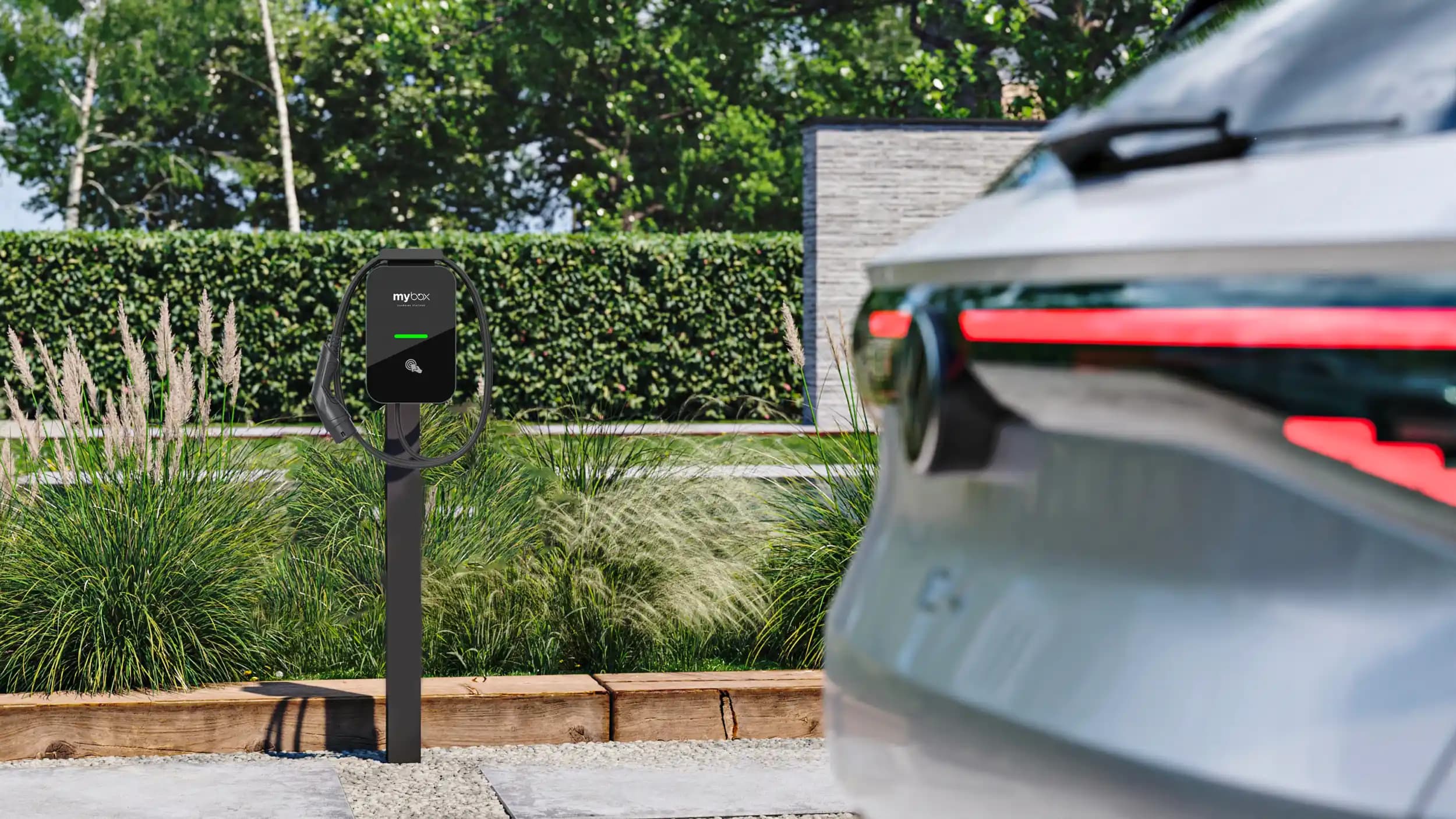
The Type 2 (Mennekes) charging connector is the common standard for charging electric vehicles in Europe. Unlike the older Type 1, it supports three-phase charging and higher power. Another advantage of Type 2 is the automatic locking mechanism, which increases safety during charging. You will also find a Type 2 cable on all MyBox AC charging stations.
CCS2 – Fast Charging for Modern Electric Vehicles
CCS2 (Combined Charging System 2) is the current standard for fast charging in Europe. It is based on the Type 2 connector and additionally has two power pins for direct current (DC) charging. Thanks to this, it supports very fast charging – typically with power from 25 to 500 kW.
CCS2 is the common connector for DC charging on new electric vehicles sold in Europe. It is used, for example, by the Volkswagen ID.3 and ID.4, Škoda Enyaq, Tesla Model 3 and Model Y, Hyundai Ioniq 5 and 6, or BMW i4 and iX. You will find it at public fast chargers, including the Alpitronic DC fast chargers that MyBox supplies and installs.
Type 1 – The Connector That Faded Out in Europe
Type 1 was originally the standard for charging electric vehicles in North America and Asia. In Europe, it was used mainly on older models, until it was replaced by Type 2. Even so, you can still come across it today – typically on older versions of the Nissan Leaf, Mitsubishi i-MiEV, Peugeot iOn, or Citroën C-Zero.
CHAdeMO – An Older Connector Type for Fast Charging
CHAdeMO is a direct current (DC) charging standard developed in Japan, which was dominant for a long time on Japanese cars. In Europe, however, it was gradually replaced by CCS2, so today you will encounter it mainly on older electric vehicles or cars from Japanese brands.
In Czechia, you will find CHAdeMO on cars equipped with a Type 1 AC connector with DC charging support. These are therefore the above-mentioned cars: the Nissan Leaf (until 2022), Nissan e-NV200, Mitsubishi i-MiEV, Peugeot iOn, or Citroën C-Zero.
CCS1 – A Connector on Its Way Out
CCS1 (Combined Charging System 1) is the counterpart of the European CCS2. However, it is based on Type 1, which is used mainly in North America.
Among the models that may have CCS1 are, for example, imported versions of the Tesla Model 3 and Model Y intended for the American market. The Ford Mustang Mach-E from the USA or the Chevrolet Bolt also have a CCS1 connector.
NACS – The New American Standard
NACS (North American Charging Standard) is a new type of charging connector that has become the dominant standard in the USA and is gradually replacing CCS1. It was developed by Tesla, which at first used it exclusively on its Superchargers. Since 2023, other major manufacturers have also begun to adopt NACS – Ford, General Motors, Rivian, Hyundai, Volkswagen, or BMW.
Can you come across cars with this modern connector in the Czech Republic? Rarely, but yes. Again, these are cars imported from the USA. For example, the few Tesla Cybertruck units driving on Czech roads have the NACS connector.
GB/T – The Chinese Charging Standard
In Czechia, you will come across GB/T only on electric vehicles imported from China that are not adapted for the European market. An example is the BYD Seagull, which is one of the cheapest electric cars on the market. The car comes with an adapter so you can charge at stations with European connectors.
Many electric vehicles are still driving in Czechia with connectors other than Type 2 and CCS2. Before visiting a used car dealership or buying an imported car, you should focus more closely on charging compatibility. Do you want to learn more about the standards, charging modes, or types of cables we use at MyBox stations? Contact us.